Neptune’s Car

Jug with Neptunes Car etched into the metal.I came across this copper spigot jug, 20 lbs, with Neptune’s Car on top and side decor (N.C.).

It was taken from a house that was being torn down.

I had bought some small items and she did not know what it was, the spigot would not turn so she gave it to me.

Could this be from the actual ship?

Editor’s Note:

I have little information on the origins of such items and refer you to Research Centers as noted on the link.

Neptune’s Car was an extreme clipper ship built in 1853 by Page & Allen, Portsmouth, VA. Jug with Neptunes Car etched into metal. The clipper’s dimensions were 216′×40′×23’6″ and tonnage 1,616 (of cargo carrying volume—old measurement).

She launched April 16, 1853 for Foster & Nickerson, New York and left New York for San Francisco October 15, 1853, arrived February 9, making the run in 117 days under command of Captain Forbes. In 1854, she sailed from San Francisco to Singapore, then from Calcutta to New York in 109 days.

Click for more on Neptune’s Car, including the story of 20-year-old Mary Patten, The Captain’s WifeMary Patten The Captains Wife who brought the clipper around the Horn in 1855 when her husband fell ill.

Extreme Clipper.com
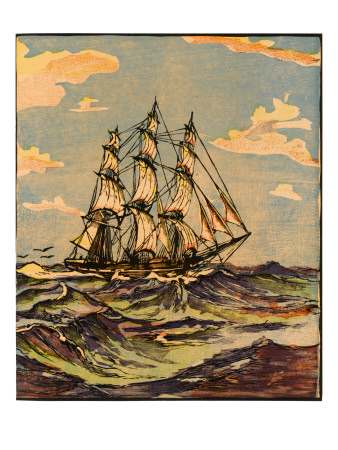
Painting of an early extreme Clipper Ship

Clipper ships ranged in size from a few hundred tons to over 4000. Between one and four hundred were built, depending on which ones you want to count as clipper ships.

Until 1845, cargo was transported in the world’s oceans in slow, high-capacity merchant ships: barques, brigs, and ships.

When San Francisco opened up to the world in the late 1840s, even before the Gold Rush, a booming economy ensued and with it a taste for exotics, such as Chinese tea. Shipping rates rose from $10 to $60 a ton. It became profitable to build and operate ships that looked less like cargo carriers and more like racing vessels. Flying Cloud (pictured above), raced the Hornet from New York to San Francisco.

The word “clipper ship” came from the fast little Baltimore Clipper, dating back to the War of 1812. The biggest of these, the Ann McKim, weighed less than 500 tons. But in 1843 it got from New York to Canton, China, and back with a load of tea in only 92 days.

Eastern seaboard ship designers began building clippers as fast as they could; for ten years,tall, elegant clippers ruled the high seas. They reached 14 knots and raced each other from port to port, sometimes with no more than a new suit of clothing as the prize.