VIPS in the Port of San Francisco
Charles Snowden Fairfax
Arrived San Francisco on the Glenmora,
October 6, 1849
Arrived San Francisco on board SS California, June
23, 1850 from Panama
Charles Snowden Fairfax, a mixture of English and Virginia aristocracy and American egalitarism, was brought up on a farm in Virginia, where his family had settled in the 1600s. He was an expert with firearms, loved to hunt and fish.
In 1849, Charles Fairfax turned 20 and fell under the spell
of the California Gold Rush. He and a group of wealthy young friends
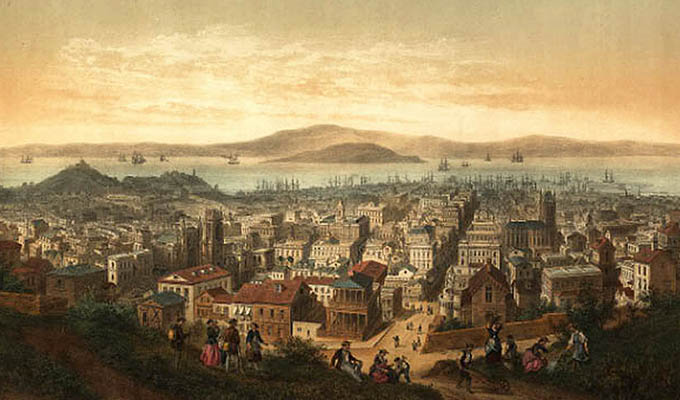
purchased the st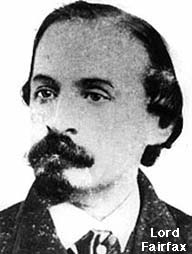 eamship Glenmora.
(Editor's note: This must have been the ship Glenmore, which is listed as having sailed from Hampton Roads near Richmond, Virginia, on April 3, 1849. It?s unlikely that a mining company brought a steamer.)
They loaded the ship with tobacco, mining equipment and supplies and set sail for San Francisco. They called themselves The Virginia Company, possibly to commemorate that historic group of adventurers who first called themselves by that name and sailed from England to Virginia to settle the colony in 1609.
When Charles Fairfax sailed West, he left behind his family, his friends, his estate and his slaves. But he took with him all the manners, mores and social skills of a Southern gentleman; those qualities proved to be more important to his success in California than his pickaxes and grubstake. Like the men of The Virginia Company, many of the 90,000 people swarming to California were young and affluent. It took money to get to California, whether by land or by sea.
The young Virginians found the Glenmora more of a liability than an asset when they reached California. San Francisco Bay was full of abandoned ships, the market for their cargo glutted. They had paid $36,000 for the ship, but only got $12,000 when they sold it. The tobacco was left to rot, and the only use they made of the merchandise was to take some of it with them when they headed for the mines.
Fairfax, who like to be called Charlie, spent his first winter in California in a log cabin in Grass Valley where romantic notions of the gold rush gave way to reality. The quality of life in the mining company was far different from Virginia.
T.H. Watkins wrote: "It was a society devoid of amenities. unless one could class alcohol, gaming tables, and a few prostitutes as amenities, devoid, in fact, of all but the very basic necessities of food and shelter: the one crude, simple and expensive; the other quite basic to the point of the primitive . . . Government, what there was of it, was by compact, in the finest American tradition, a form pared down to a skeleton of simple laws designed mainly to keep men from constantly robbing and murdering one another."
He was "The Baron" to all his friends, since he actually was heir to the title in England, although the family had lived for generations in America. He was a clerk in the Supreme Court at Sacramento, but commuted to San Francisco weekly or more often, and was one of the early members of the Pacific Club, where his wit and good-fellowship made him a favorite.
Fairfax apparently never found any gold, but by 1851, he was head of the Marysville Committee of Vigilance. He'd found his profession and from then on was a politician.


After holding various offices and holding forth in California's burgeoning society, a friend gave him a marriage gift of 32 acres in beautiful Marin County, where he lived with his bride between 1855 and 1868. The acreage, originally named "Bird's Nest Glen," is now the small town of Fairfax.

Site Search
A List of Books: Californiana and the Pacific
Augustin Sylvester Macdonald

Pioneer Urbanites: A Social and Cultural History of Black San Francisco
Douglas Henry Daniels


The Literature of California, Volume 1: Native American Beginnings to 1945

Twenty Thousand Roads: Women, Movement, and the West
Imperial San Francisco: Urban Power, Earthly Ruin
(California Studies in
Critical Human Geography)
San Francisco History Books
Cultural Frontiers

Mud, Blood, and Gold: San Francisco in 1849
Rand Richards

 Copyright ~ 1998-2018.