Ship's Store: Books
Ports of the World
° 49ers 'Round The Horn ° Australia ° California (Fiction) ° Captains ° Children ° Chinese in San Francisco ° Culture of Early America ° Geneaology ° Merchants ° Passages ° Passengers ° Seaports ° San Francisco History ° Ships and Shipping ° Tales of the Sea (Fiction) ° Naval History ° Sea Politics ° Spanish in California ° Women at Sea
Books and images are also throughout the site under various topics.
  |
Lloyd's List Ports of the World 2008
John Fossey |
  The CIA World Factbook 2015
From Afghanistan to Zimbabwe, The CIA World Factbook 2015 offers complete and up-to-date information on the world s nations. Perfect for travellers, armchair travellers, students of history, government or world history . Iincludes an overview of languages, literacy rate, government type, capital, administrative divisions, legal system, executive and judicial branches, political parties and leaders, international organization participation, diplomatic representation in the U.S., communictions, transportation, military, etc. |
|
 |
A Brief History of the Caribbean |
  |
Ports of the World : Prints from the National Maritime Museum, Greenwich c.1700-1870 Cindy McCreery |
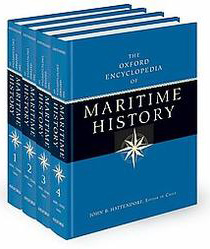 The Oxford Encyclopedia of Maritime History: Four-volume set
Excerpted from Booklist: Much more than the usual naval battles, warships, and nautical terms, this impressive and wide-ranging A-Z encyclopedia seeks "to be a reference work for the entire field of maritime history." Editor Hattendorf (president of the American Society for Oceanic History) heads an inspiring list of over 400 primarily international contributors in an attempt to integrate maritime history into a global economic, cultural, military, and political context. More than 900 entries are detailed and multidimensional. For example, Wars, maritime includes 11 subentries and covers 56 pages. This integrated approach would be separate and distinct in other encyclopedias. |
|
 
The son of a well-to-do butcher, Defoe became a London tradesman and merchant. He was well educated and kept notebooks from an early age in which he wrote short fictions. He also daydreamed about adventurous voyages in the South Seas and was excited by the prospect of colonizing new (and utopian) lands. These ideas were to bear fruit in his great work, Robinson Crusoe |
A Journal of the Plague Year
Daniel DefoeDefoe's account of the bubonic plague that swept London in 1665 remains as vivid as it is harrowing. Based on Defoe's own childhood memories and prodigious research, A Journal of the Plague Year walks the line between fiction, history, and reportage. In meticulous and unsentimental detail it renders the daily life of a city under siege; the often gruesome medical precautions and practices of the time; the mass panics of a frightened citizenry; and the solitary travails of Defoe's narrator, a man who decides to remain in the city through it all, chronicling the course of events with an unwavering eye. Defoe's Journal remains perhaps the greatest account of a natural disaster ever written. This Modern Library Paperback Classic is set from the original edition published in 1722. From the book: "It was about the Beginning of September 1664, that I, among the Rest of my Neighbours, heard in ordinary Discourse, that the Plague was returned again in Holland; for it had been very violent there, and particularly at Amsterdam and Roterdam, in the Year 1663, whether they say, it was brought, some said from Italy, others from the Levant among some Goods, which were brought home by their Turkey Fleet; others said it was brought from Candia; others from Cyprus. It mattered not, from whence it come; but all agreed, it was come into Holland again . . . " |
 
|
Asia: China
|
 
|
The Atlantic World: Europeans, Africans, Indians and Their Shared History, 1400-1900
The Atlantic World: A History, 1400 - 1888
Douglas R. Egerton, Alison Games, Kris Lane, Donald R. Wright Empires of the Atlantic World: Britain and Spain in America 1492-1830J.H. Elliott Atlantic History: A Critical Appraisal (Reinterpreting History)
Jack P. Greene, Philip D. Morgan, Editors A Cultural History of the Atlantic World, 1250-1820
John K. Thornton |
 |
Australia The Fatal Shore: The Epic of Australia's FoundingRobert Hughes |
 |
The Barbary Wars: |
 |
CanadaSelected Memoirs of Port Royal: To Which Are Appended Tour to Alert, Visit to Port Royal, Gift of an Abbess, Biographical Notices &c. Taken from Original Documents, Volume 2
|
 |
"The Dearest Birth Right of the People of England": The Jury in the History of the Common Law
Grant Macleod, John W.Cairns, Editors
|
Havana and the Atlantic in the Sixteenth Century (Envisioning Cuba)
Havana in the 1550s was a small coastal village with a very limited population that was vulnerable to attack. By 1610, however, under Spanish rule it had become one of the best-fortified port cities in the world and an Atlantic center of shipping, commerce, and shipbuilding. Using all available local Cuban sources, Alejandro de la Fuente provides the first examination of the transformation of Havana into a vibrant Atlantic port city and the fastest-growing urban center in the Americas in the late sixteenth century. He shows how local ambitions took advantage of the imperial design and situates Havana within the slavery and economic systems of the colonial Atlantic. The Year of the Lash:
Free People of Color in Cuba and the Nineteenth-Century Atlantic World (Early American Places)
Michele Reid-Vazquez A Concise History of the Caribbean (Cambridge Concise Histories)B. W. Higman Havana: History and Architecture of a Romantic CityMaria Luisa Lobo Montalvo, Author; Lorna S. Fox, Translator; Hugh Thomas, Contributor. | |
 |
Venice, A Maritime Republic
Frederic Chapin Lane |
 |
The Persian Gulf: A Political and Economic History of Five Port Cities 1500-1730Willem Floor The Political Economy of the Persian Gulf (Columbia/Hurst)Mehran Kamrava Travels through Northern Persia: 1770-1774
Samuel Gottlieb Gmelin, Author; Willem Floor, Translator |
|
|
  |
South America: Brazil, Rio de JaneiroTropical Versailles: Empire, Monarchy, and the Portuguese Royal Court in Rio de Janeiro, 1808-1821(New World in the Atlantic World) Kirsten Schultz |
 |
Grimsby: The World's Greatest Fishing Fleet Peter Chapman During the 19th century Grimsby fishing fleet greatly expanded, some streets were paved and lit by oil lamps. After 1838 gas light was used. In 1837 the first police force in Grimsby was formed. In 1854 a water company was formed to provide piped water (to those who could afford it). Also in the 1850s sewers were dug under Grimsby. A new Town Hall was built in 1863. |


 .
. 





 Copyright © 1998-2017.